Our fourth and final annual meeting of the DFG-funded research network Russian Ecospheres will take place in the context of “Climate Change Adaptation” from the 27th of February till 1st of March 2025 at GWZO in Leipzig.
Together with scholars from various disciplines, including historiography, geography, literary and cultural studies, anthropology and the natural sciences, historical lessons will be learnt from policies of adaptation from the 18th to 21st century.
Program and Accession
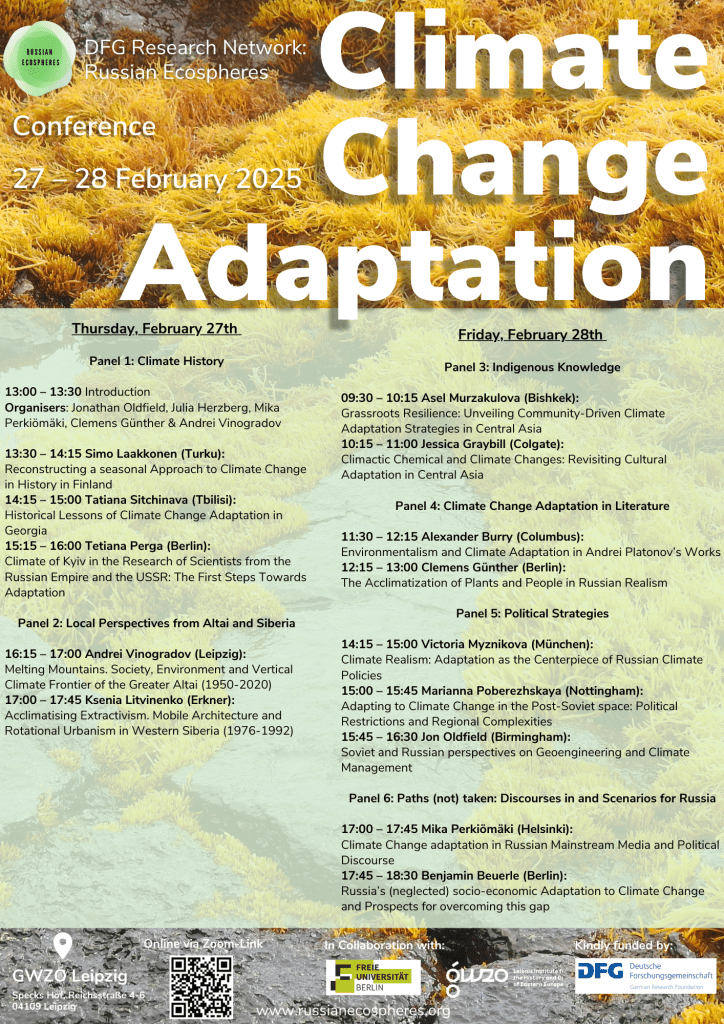
The conference program on February 27th and 28th is open to the public. Scholars and guests are asked to present small- and large-scale case studies on adaptation, its discursive implications and technological practicability in Eastern Europe and the former territories of the Russian Empire and the Soviet Union.
Preliminary Content
As meeting the 1.5-degree benchmark for limiting the effects of climate change becomes increasingly implausible, the technological and social discussion is moving towards adaptation. Adaptation features prominently in the most recent synthesis report of the IPCC (Intergovernmental Panel on Climate Change), and formed a key theme at the 2023 UN Climate Change Conference (COP 28). There are, however, also gaps and barriers in adaptation policies, mostly caused by insufficient funding and inadequate technology in addition to the complex character of the climate change process. Philipp Staab (2022) argues that this gradual shift from mitigation to adaptation illustrates a greater shift from (self-)development to (self-)preservation in society, opposing the modernist agenda of democratization, emancipation and individualization. This recent reappraisal of adaptation as policy and concept prompts the question: how and what can contemporary discussion learn from historical experience? As sociologists like Talcott Parsons have argued, adaptation is a structural means of human behavior and social order. This also holds true for the adaptation to changing environmental conditions, both in short- and long-term perspective.
The regions and countries of the former Soviet and Russian empires promise to be particularly rewarding case studies in this respect, considering the area’s marked climatic zonal shifts and the prevalence of extreme weather and climate events. Furthermore, the area encompasses a range of competing adaptation approaches and traditions including, for example, the large-scale technocratic focus of Soviet and Russian managerialism, the more nuanced, local level adaptations at the national, regional and local levels, and the enduring, lived adaptations of indigenous peoples. Its history also embodies the ambiguity and dialectics of adaptation, namely the human adaptation to environmental conditions and the adaptation of environmental conditions to human needs.


Funded by:
Coordinated by:



 "Russian Ecospheres"